
Quantity grid
The quantity grid is part of AddOnBoss Pro.
When a product comes in a colour and a size, a customer buying for a team does not want to add one line at a time. A quantity grid lays out every colour against every size and lets them type a quantity into each cell, then add the whole run to the basket in one go.
Turn it on
Section titled “Turn it on”- Attach a colour set and a size set to the product on its Product Options panel.
- Under How customers order this, turn on the quantity grid.
- Update the product.
The product’s page now shows the grid: colours down one axis, sizes across the other, a quantity box in every cell.
What the customer does
Section titled “What the customer does”The customer types a quantity into each cell they want, 5 small navy, 10 medium navy, 5 large red, and the grid keeps a running total and a running price as they go. One Add to cart puts the whole run in the basket, adding a line for each colour and size combination they entered.
Prices on choices
Section titled “Prices on choices”You choose what each choice says about its price, with a Prices on choices control on the product’s Order layout panel. It covers the grid’s cells and the option chips on a one-at-a-time page alike:
- Automatic keeps the standard behaviour: surcharge figures on the grid, and chips that dress themselves in whole prices where one priced set makes that the honest reading, or differences otherwise.
- Differences only marks just the choices that cost more, with a figure like +1.50, which is the number that surprises people at the till.
- Every price prints each choice’s own full price, for shops whose customers expect a figure against everything.
- Hidden shows no figures on the choices at all. The running total still tells the money story, and what is charged never changes whichever you pick.
A set where shoppers pick several keeps difference figures whatever you choose, because those picks add up, and a full price on each would promise several different totals for one item. On the size-run matrix the figures sit under the size headings instead of in the cells, and only where every colour agrees on the figure; a size the colours price differently stays quiet rather than showing a number that is only sometimes true. Picture cards in the grid always carry their own price.
Choices for the whole order
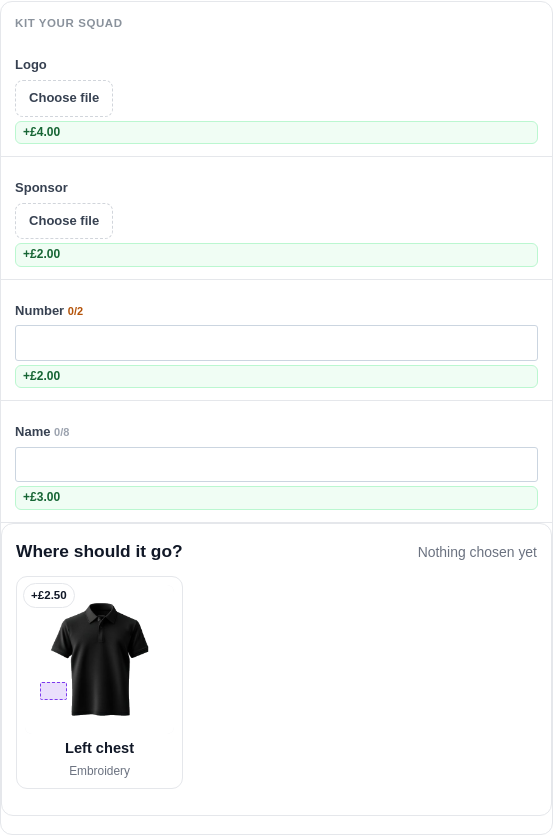
Section titled “Choices for the whole order”The grid itself is built from two sets, your main choices, usually a colour and a size. Any further set you attach is offered once for the whole order beneath the grid rather than per cell, so the customer chooses the print method once and it applies to the whole run.
You choose which two are the mains on the Product Options panel, and each whole-order set carries its own charge setting: per item, which rides every shirt in the run, or once, a single setup charge however long the run is. See pricing & fees.
Where they can take several
Section titled “Where they can take several”A whole-order set can let the customer take more than one choice. “Pick up to two print print areas” sits beneath your size and colour grid, they take Front chest and Full back, and both are charged. The rule they read is the one you set, “Choose up to 2”, and a pick past it is refused on the page and again at the till.
If those choices carry photos they draw as photo cards here too, with a tick on each one taken. That is the point for a printed-garment shop: a picture of each print area beside the grid, not a list of words.
The running total names the set once and lists what they took underneath it, with its own subtotal, so a customer who has taken two print areas sees both and what each one cost.
What a grid will not carry
Section titled “What a grid will not carry”Two things cannot ride a grid, and the product’s Order layout panel names them rather than letting them disappear quietly:
- A set that only appears under a condition, because the whole-order block has no way to reveal it.
- A price table or a measured size, because a shopper picks one size for the whole order there, not a size per cell.
Where the panel names a set, it also says plainly that the set will not be shown and will never be charged, so you can move it or switch that product back to One at a time.
Quantity breaks in the grid
Section titled “Quantity breaks in the grid”If the product carries quantity discounts, the whole run counts toward the breaks as one order: 8 Medium, 8 Large and 9 XL polos are 25 polos, and every one takes the 25 price. The breaks table sits with the grid, and the moment the customer picks an option with a per-item price it gains the With your options column, so someone weighing up 25 printed polos reads the printed polo’s break price, not the bare garment’s.
The total follows you down the page
Section titled “The total follows you down the page”A bulk order is a long page, and the running total and Add button sit at the bottom of it. Once they scroll out of sight a slim bar takes their place along the bottom of the screen, carrying the order’s total, how many items are in it, and its own Add button.
Tapping the figure lifts the order summary up out of the bar, so a customer can check what is in the number without scrolling back. The bar stays away until there is something to add, and its button is never willing when the grid’s own is not.
Nothing to set up: it appears on its own where it is needed, on phones and on desktop.
Prices with or without tax
Section titled “Prices with or without tax”The grid can show its cell prices and totals with or without tax, to match how your trade customers expect to read them. Set it to follow your shop’s display setting, or force one way where a wholesale range is always quoted without tax.
After adding
Section titled “After adding”Adding the run does not whisk the customer away to the basket; the grid stays in place with a confirmation, so they can add another run or carry on. Each colour and size lands on the order as its own line, named the way it was chosen, so the pick list reads cleanly for the warehouse.
Pair the grid with print areas so a team order can carry a logo placement for the whole run, chosen once above the grid.