
Custom fields
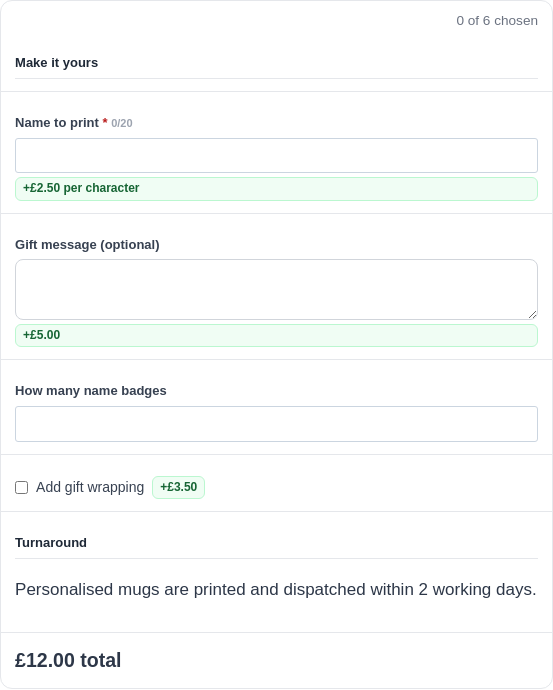
Beyond a list of choices, a product can take fields a customer fills in. A name to print, a gift message, a quantity, a tick box for gift wrap, a dropdown of finishes. Fields sit on the Product Options panel next to your option sets, and what the customer types flows to the order and the pick list with the rest.
A product can offer fields on their own, with no option sets at all. A plain mug with just a “Name to print” line is a perfectly valid AddOnBoss product.
Field types
Section titled “Field types”Fourteen types come with the free plugin. Two more arrive with Pro.
- Text, a single line, for a name or a short message. Can be priced per letter.
- Text area, several lines, for a longer message. Can be priced per letter.
- Number, a plain number, for a count or a quantity.
- Date and Time, for a delivery date or a slot. With Pro they grow into Date, with lead time and rush charges and Time of day, in slots: the calendar only offers dates you can meet, the list only offers times you can work, and coming in sooner or at the busy hour can cost more.
- Dropdown, a list of set choices where a full option set would be too much. Each choice can carry its own fee. Past a couple of dozen choices the list becomes a box you can type into, so a long list of fonts or thread shades is searched rather than scrolled.
- Tick box, a yes or no add-on, like gift wrapping.
- Colour, swatches the customer picks from, with an optional Custom entry for a shade you have not listed. Useful for ink, thread and vinyl.
- Name your price, where the customer types the amount. A gift card value, a donation, a deposit. Offer a few amounts as chips and they can still type their own. Set a minimum, a maximum or both, and the field prints them under the box and refuses anything outside them.
- Email address, checked as it is typed. An obvious slip in the domain gets a quiet "Did you mean …?" rather than a rejection, so the recipient address on a gift order does not arrive wrong.
- Web address, for a link to print on a card or a sign.
- Hidden value, which the customer never sees. You set it, and it travels to the cart and the order with everything else. Useful for a job code or a routing note for whoever makes the item.
- Section label and Info block, display only. A label heads a group of fields; an info block shows a note or a bit of guidance. Neither is filled in and neither is charged.
Two further types come with Pro:
- File upload, for a logo or print-ready artwork. See file & artwork uploads.
- Measured size, where the customer types a width and a height and the price follows the area. See measured pricing.
How a field is priced
Section titled “How a field is priced”Each field can carry a fee, and you choose how that fee behaves:
- Once for the order. A flat charge added once to the line, however many the customer buys. A setup fee or a fixed personalisation charge.
- Per item. The fee is added to every unit on the line, so buying three adds it three times. Gift wrapping each piece.
- Per letter. For a text field, the fee is multiplied by how many characters the customer types, then applied per item. An engraving line that costs more the longer it is.
Per-letter and percentage pricing are part of AddOnBoss Pro, as are the file-upload and measured-size field types. All fourteen other types, with a flat or per-item fee, are free.
A one-off fee is a whole-line charge. If a customer buys five, the fee is still charged once, not five times. A per-item or per-letter fee multiplies through WooCommerce's own line maths as you would expect. See pricing & fees.
Ask for a field more than once
Section titled “Ask for a field more than once”A field normally asks once per line. Some products need the same question answered several times: a name for each of the shirts in the basket, a line of engraving per glass. Each field carries an Ask for setting with three answers:
- Just one. The usual single question.
- As many as they want. The customer starts with one and presses Add another, up to a cap you set with Up to. The button names what it adds, “Add another engraving”, and at the cap it says so plainly, “That’s the most we can add (4)”. A small cross removes a copy.
- One for each item they buy. The number of copies follows the quantity box. Set the quantity to three and the page asks three times, before anything is added to the basket, so you never chase missing names afterwards.
Call each one names the copies: type “Shirt” and the customer sees Shirt 1, Shirt 2, Shirt 3, and the admin panel previews exactly what shoppers will see. With one-per-item, the copies fold away as they are answered, each header showing a tick and what was typed, and the first unanswered one sits open, so ten names never become a wall of inputs.
At trade quantities the page changes shape entirely: past a dozen or so, a single text field stops drawing cards and asks for the whole list in one box, one entry per line, with a live count of how many are filled in against how many the quantity needs. Pasting straight from a spreadsheet works. The cart shows the list as one tidy summary row, while the order itself keeps every entry for whoever packs it. This pairs naturally with quantity discounts, where fifty of something is a normal order.
Repeating a field or a group is part of AddOnBoss Pro. On the free plugin the field simply asks once; a repeat setting you have saved is kept, not lost, so it takes effect the moment Pro is active.
A group of fields repeats as one block
Section titled “A group of fields repeats as one block”Where each copy needs several answers, the words, the font and the colour of one engraving, put the fields in a group (the Add a group button on the Product Options panel) and set How many times to ask on the group itself. As the panel puts it: all fields in the group repeat together, as one block per copy, and each field keeps its own charge.
The customer fills in Engraving 1 whole, words, font and colour together, then Engraving 2, rather than typing all the words and then all the fonts. Each answer lands on the cart and the order under its block, “Engraving 1: Words”, “Engraving 2: Font”, and if a required field in one block is missed, the notice names it exactly, “Engraving 3: Words”.
Once a group holds two or more fields, the group’s setting is the only one that counts; the members’ own Ask for settings stand down rather than multiplying on top of it.
How repeats are charged
Section titled “How repeats are charged”Each copy is charged as its own answer, by each field’s own fee mode. Three £5 engraving lines cost £15, whether the customer added them or the quantity asked for them; a “once” fee inside a block, a £12 setup say, is charged once per block. A one-per-item fee is never multiplied by the quantity a second time: three shirts at £10 with a £5 name each is £45, not £75. See pricing & fees.
When the quantity comes back down
Section titled “When the quantity comes back down”With one-per-item copies, lowering the quantity removes the spare blocks from the end. If a removed block had been filled in, the page says so rather than losing the words silently: “Fewer items than engravings, so we removed Engraving 3. Their details were cleared.” The change is never blocked; the customer is simply told. With “as many as they want”, the customer removes copies themselves, so there is nothing to warn about.
A product ordered through the quantity grid has a quantity per cell rather than one for the line, so there is no single number for one-per-item copies to follow: those ask once, and a repeating group stands down whole. "As many as they want" still works, applying to the whole order. The admin panel points this out on the spot, so nothing stands down silently.
Optional, required, or required only when personalising
Section titled “Optional, required, or required only when personalising”Each field is one of three:
- Optional. The customer may leave it blank.
- Required. The customer must fill it in before the product can be added to the basket. AddOnBoss names the field in the notice if it is left empty.
- Required only when personalising. The field is optional, but if the customer starts personalising the product, it becomes required. A “print area on garment” field that only matters once a name is being printed.
Reveal a field only when a choice is made
Section titled “Reveal a field only when a choice is made”A field can wait, hidden, until an earlier option set has a certain value. A “Thread colour” field can appear only once the customer has chosen the Embroidery finish. While hidden the field is inert: nothing is charged and its required flag never fires, and anything already typed clears until it reappears. Set the rule the same way you would for a set; see conditional options.
Limit the length
Section titled “Limit the length”A text or text area field can carry a maximum length, so a name that has to fit an embroidery hoop cannot run past what will fit.
On variable products
Section titled “On variable products”A field can be restricted to certain variations, so a “Sleeve length” line shows only for the long-sleeve variation and stays inert for the rest. Leave the restriction empty and the field applies to every variation. See options on variable products.
Where the values go
Section titled “Where the values go”Everything a customer types lands on the cart line, the order, the confirmation email and the warehouse pick list, labelled with your field name (“Name to print: SAM”). Uploaded files and entered values are covered by WooCommerce’s personal-data export and erase tools.